

- Start from the eligible universe.
- Compute derived fields.
- Keep securities where the filter expression is true.
- Rank the remaining securities by score, highest first. If you set a maximum, keep the top N.
- Weight each selected security by the weight expression, or by score when the weight expression is blank. Scale the weights to sum to 100%.
- Apply concentration caps by issuer and redistribute the removed weight so the portfolio remains at 100%.
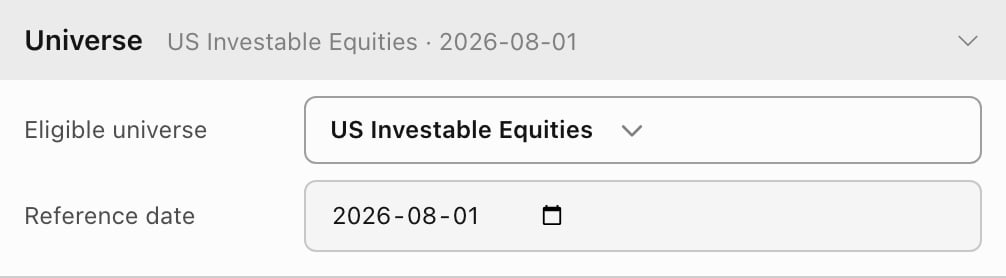
Universe
index("<name>") > 0 to the filter.
The reference date anchors size-segment eligibility to a point in time. Tilt then takes size segments from recorded history with buffer bands, so a company near a size boundary stays put through small price moves.
Filter, score, and maximum constituents
The filter expression sets eligibility. A security that fails it drops out. The score expression ranks eligible securities, highest first. Maximum constituents keeps the top N ranked securities and requires a score expression. With no score expression, the Tilt holds every security that passes the filter.Position sizing

A constant weight such as
1 gives each listing of a multi-listing company its own full position. theme() selects companies, so size a thematic Tilt by score and leave the weight expression blank. Tilt rejects a weight expression on a company-level selection when a selected company has more than one listing.
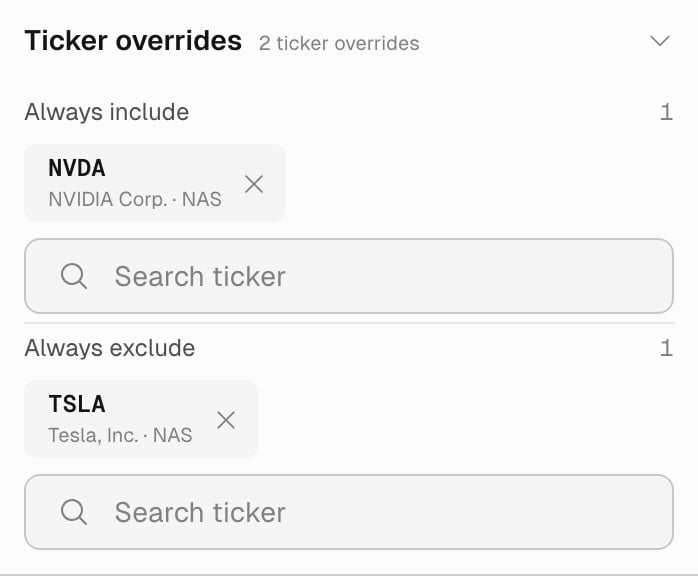
Ticker overrides
Rebalance and concentration
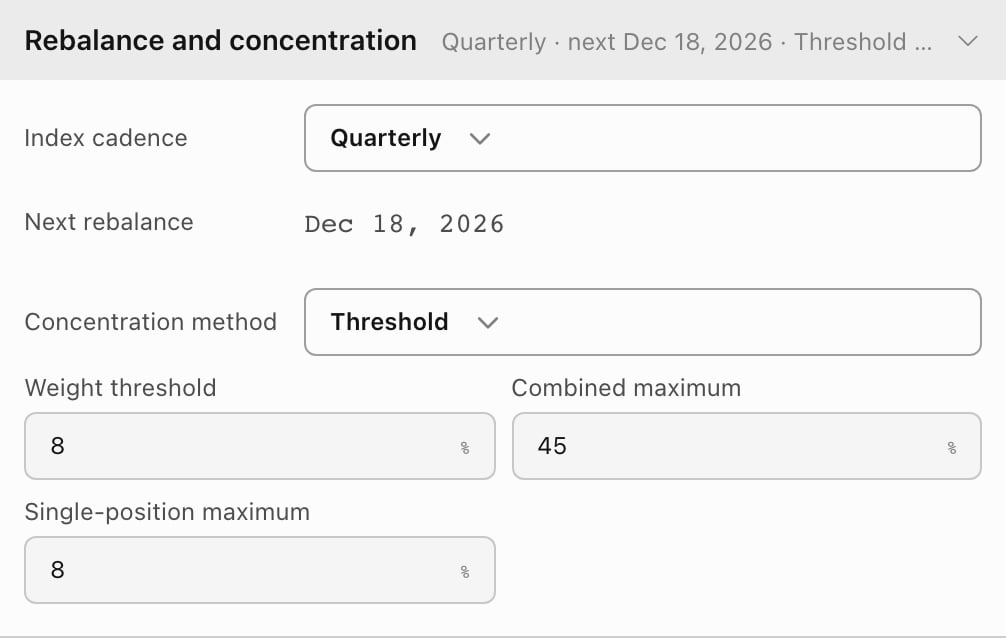
index("<name>") > 0 and you set no cadence, Tilt adopts that index’s published reconstitution schedule.
Concentration method caps issuer weights after selection and sizing. When an issuer has multiple listings, Tilt combines their weights before applying the limits:
Top N and Threshold also accept a single-position maximum. Leave any limit blank to turn it off.
When a cap reduces an issuer’s weight, Tilt redistributes the removed weight proportionally among issuers that can receive it without exceeding the limits. The final weights sum to 100%. Tilt then divides a multi-listing issuer’s final weight based on each listing’s free-float market capitalization. If Tilt cannot calculate that split from float data, it preserves the listings’ relative weights from before capping.